
By Tyler Dunn
In so many ways, Haley and Hanna Cavinder are easily recognizable. Twin sisters, counting down the days until graduation. Glued to their phones, managing the intricate social network of 17-year-olds. Talking quickly, in frantic partnership. Model students, athletically gifted.
That last part might be an understatement, though, in the Cavinders’ case. The seniors, who star for Gilbert High School’s girls basketball team, can ball.
“Their style of play is upbeat, fast, aggressive, very physical,” said the pair’s head coach, Kyle Pedersen. “They shoot well beyond NBA [range] consistently.”
Pedersen said from the first time he saw them, the twins were euro-stepping through 17-and-under teams — as sixth graders.
That kind of obvious skill has placed them among the Arizona high school basketball elite and onto the radars of collegiate scouts across Division I basketball for years.
But scholarships are competitive, with only about 1 percent of girls basketball players going on to play for a Division I program, according to the NCAA. And not every girl with the Cavinders’ talent makes it to collegiate athletics.
It requires certain intangibles, a little bit of luck and — in Haley and Hanna’s case — it doesn’t hurt to have each other.
Package Deal
Gilbert High’s first game of the 2018 season was never in doubt. The Cavinder sisters poured in 53 of their team’s 69 points against an overmatched Desert Mountain High School squad, but you wouldn’t know it as the two stalked off the court. Haley’s 13 hard-fought rebounds, Hanna’s four made 3-pointers, each a distant memory as they grumbled to each other about their first-half play.
Pedersen said it was hard for the girls to rein in their emotions in their early days with him — so much so, he remembers, they’d tend to ignore his outstretched high-five hand when he’d summon them to the bench. Now, as the unquestioned leaders of the team, Pedersen said the Cavinders have learned to channel that fire.
“They raise the level of everybody around them,” Pedersen said. “They’re so competitive, they want to win . . . everybody kind of starts feeding off that too.”
The feistiness the girls have developed is crucial to their success. At just 5’6”, Haley and Hanna Cavinder play with an edge because they need to; they drive into the lane with force because they need to.
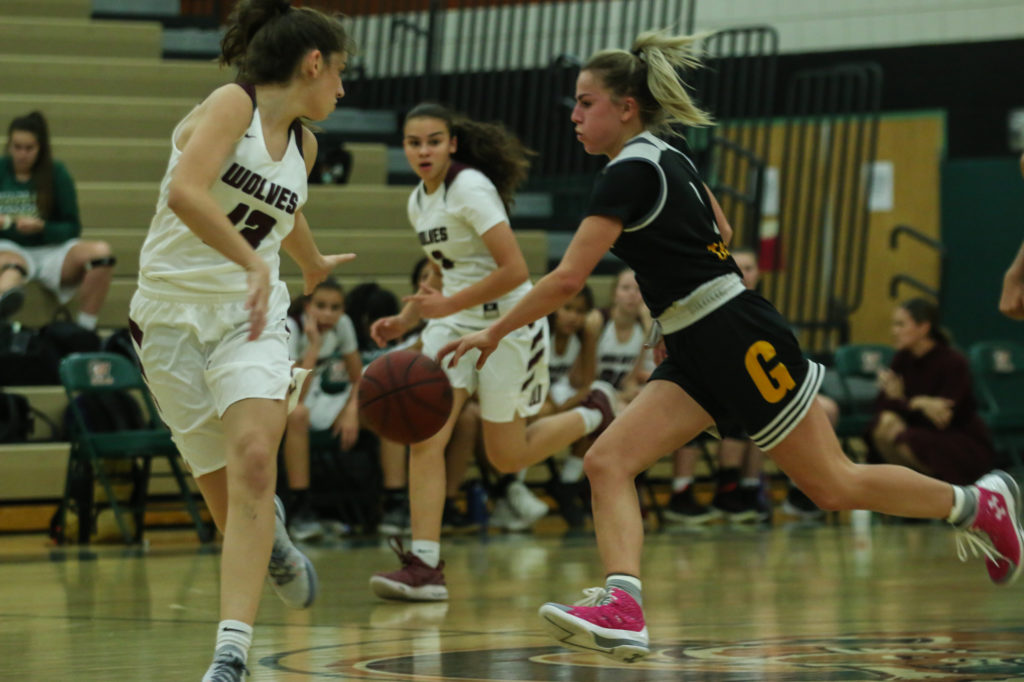
Size is an unavoidable factor in basketball, though, and the jump from high school to college is enormous. For some top-level schools, no amount of competitiveness will make 5’6” palatable. For even more schools, offering two prized scholarships to players so undersized would be far too risky.
Some schools expressed interest in Haley Cavinder, who ESPN rates as the 27th best senior point guard in the country, over her sister, who ranks 71st. At least one school, the sisters said, asked Hanna to sit out her first year as a redshirt.
But for the Cavinders, that wasn’t an option. They’d play, and start, alongside one another. It’s what they’d always done.
“We’ve always played basketball together,” Haley Cavinder said. “That was always a dream of ours, just to play together.”
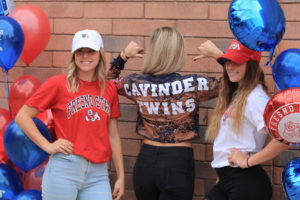
The sisters say they made that known to interested schools, and after two official visits and steady consultation with family and one another, made their decision. On Nov. 14, the Cavinders donned Fresno State hats for National Signing Day in front of a packed Gilbert High School foyer.
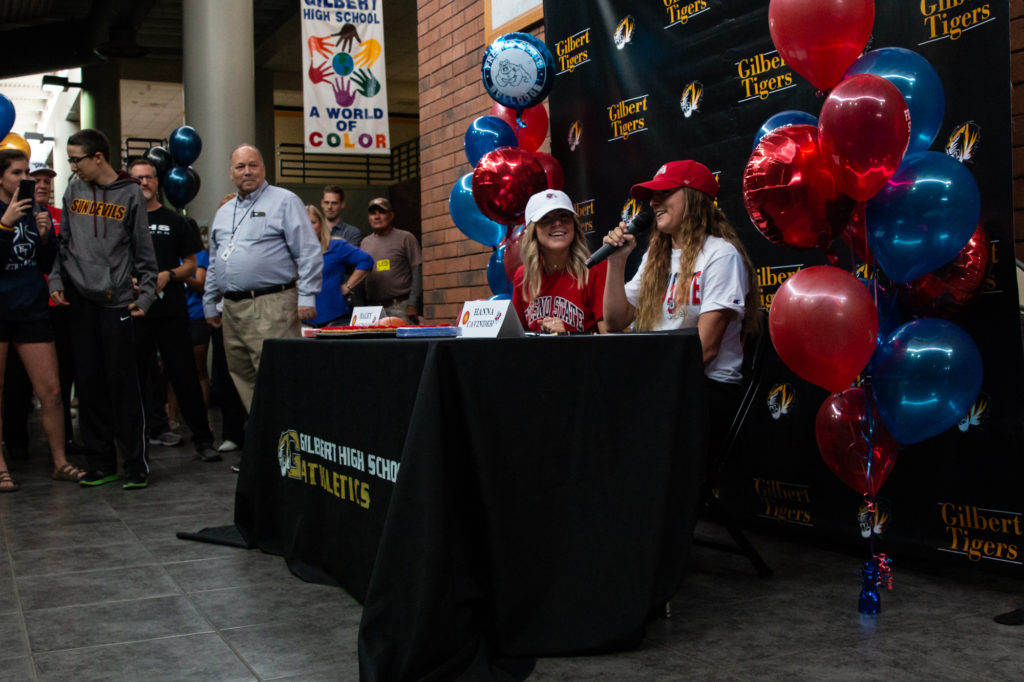
“They’ve always been super close. If they were going to continue on playing basketball, I was hoping that they would go together,” their mother, Katie Cavinder, said. “And it’s a short flight.”
Haley and Hanna Cavinder said the only disagreement they had over the recruitment process was the timing. The sisters verbally committed in April, a decision made early to ensure both Cavinders would have a spot on the Bulldogs’ roster.
“We were a little nervous about it, just because they had a whole summer left ahead of them,” Katie Cavinder said. “But once they went out there, they just had the feeling.”
Sister, Sister
To speak to the Cavinder twins is to feel, faintly, that you’re not entirely in on the joke. It doesn’t come off as rude as much as you’re bearing witness to a chemistry that isn’t yours.
It’s in part chromosomal, to be sure. But they’re also best friends, and have spent their formative years developing off of and alongside each other.
Hanna is the outgoing one and enjoys her English class; Haley’s a little more shy and prefers math. Haley’s a natural point guard, setting up plays and orchestrating the offense. Hanna can do those things too, but is more likely to slip behind a screen and launch a deep three.
“Probably like Maya Moore,” Haley said, comparing her sister’s playing style to the WNBA All-Star and four-time champion. “Maya Moore can literally do anything and I think that’s what Hanna brings.”
Hanna doesn’t skip a beat.
“I don’t know, I feel like, she’s like,” she said, shifting to her sister, “you’re kind of like Sue Bird . . . you’re really good at creating for others.”
And when they attempt to explain what it’s like to play with one another, neither can adequately put it into words.
“Honestly, it’s really hard to talk about what it feels like, but it’s just an awesome feeling,” Haley said. “She wants to win just as bad as I want to win. I know where she is on the court. Because we play — we have that chemistry — we play every single game together.”
You Have a Friend Request
As much as being twins has helped the Cavinders on the court, it’s also allowed them to wade through the muck of college recruitment arm-in-arm.
Their exposure to that process didn’t start last year, when they helped lead the Gilbert Tigers to the 6A conference semifinals.
“Probably freshman summer,” Hanna said, thinking back to when they were originally recruited. “That’s when we picked up our first offer from the University of San Diego.”
Except that’s not the full picture, either.
The sisters have been preparing to one day play college basketball ever since their middle school meeting with Coach Pedersen, their mom recalled. And as both girls aren’t shy about sharing, their dad insisted they keep their social media profiles private. Coaches could be watching.
In fact, coaches have been watching. Haley and Hanna say they’re constantly getting follow requests from team officials they’ve never met. They sluff it off as they explain what would, in just about any other context, be bizarre behavior — middle-aged strangers reaching out, monitoring every tweet or Instagram story. It’s just part of being a coveted athlete in 2018.
Victoria Jackson, a sports historian at Arizona State University and former Division I athlete, said it’s a more invasive ordeal than ever for college recruits.
“Every night, my mom acted as kind of like my secretarial assistant to vet phone calls,” Jackson remembered. “The rules have changed since when I was being recruited, to the point where there’s even more touches and taps from coaches permissible now.”
The swirl of outside attention, Jackson said, can often lead athletes to have a warped perspective on their place in the universe.
“It’s really hard to keep your eyes on the prize as a 17-year-old,” Jackson said, “and have the maturity to ignore all the shiny bells and whistles and focus on what’s really best for you.”
Such a life-changing decision to make, all while not knowing if you can reply to this coach’s post, or who you might go to prom with, or if you’re allowed to take that free T-shirt, or how to improve your SAT score.
“At the end of the day, you’re making a decision about four to five years that has incredible implications for the future of your education, your career, your well being,” Jackson said. “It’s a really important decision you’re making about where to go on and live and perform.”
The Decision
Outside of their choice to play at Fresno State, the Cavinder twins aren’t committing to much else. They said they don’t know what they want to major in, or what they plan to pursue after college.
Ask them about professional basketball and you’ll get a complicated answer.
“I don’t want to go to the WNBA. If there was an opportunity to play overseas, I’d maybe take that,” Haley said.
Hanna followed up in agreement, saying she would love to play internationally, but isn’t focused on the WNBA.
“If there is a chance, I totally will take it. It is really hard to get there,” Hanna said. “After Fresno [State], if the opportunities aren’t there, you just need to be ready to close that door and start a different chapter.”
It’s slightly stunning to hear. After all, these are two of the best girls basketball players in the state. And at least in the eyes of their coach, “the sky’s the limit.”
“I 100 percent think they could play professionally. I know a lot of people who play professionally now and I think they’re very close to that,” Pedersen said. “I think they for sure could be playing in college right now.”
So why not the WNBA? For one thing, the money could be better. WNBA players have long made far less than their male counterparts.
Phoenix Mercury star Diana Taurasi famously bolted from the league to play in Russia for the 2015 season, where she made nearly $1.5 million, according to ESPN. The maximum salary for WNBA players that year was $115,000.
Earlier this month, WNBA Players’ Association President Nneka Ogwumike announced in a Players’ Tribune post the players will opt out of the current CBA at next season’s end.
“I want young female athletes to dream about playing in a vibrant and thriving WNBA,” Ogwumike wrote. “I want them to dream of having it all.”
One reason girls might not be dreaming of professional basketball, at least not in the way boys across the country have for decades, is societal messaging, Jackson said. The ASU historian said expectations are ingrained differently based on factors like gender, from the time children are five years old.
“We go pro in something other than sport,” said Jackson, reciting the familiar NCAA slogan. “And we use sport as a way to earn a college degree . . . That messaging is so much more transparent with female athletes.”
The Cavinders are entering a new phase of their lives. And they have plenty of questions they’ll be asking of themselves over the next few years. But that’s just part of being a teenager in 2018.
They may play professional basketball. Or maybe they will start a business, the girls say to each other. A coffee shop, or even a hotel.
“We have each other,” Hanna said, sharing a look with Haley. “We are going in knowing we have a sister and a best friend.”
Corey Kirk, Bradey King and Lamar Smith contributed to this story.