
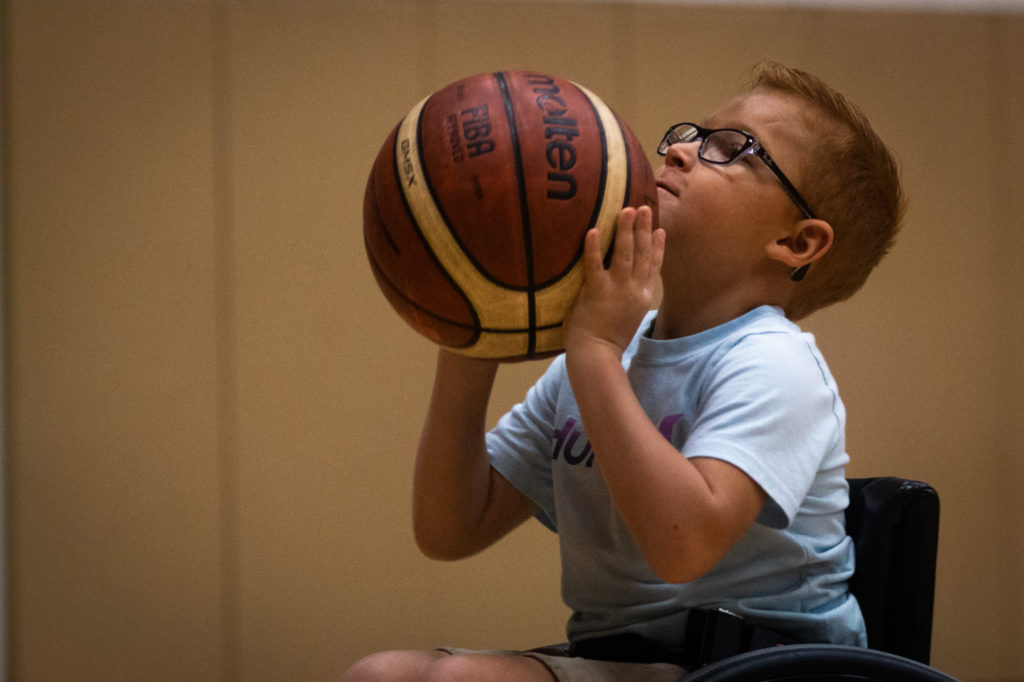
Ben Goss is 23. He’s an athlete with aspirations of competing at the highest level in front of a global audience.
To achieve this, he moved from his home in Massachusetts to Phoenix. “Once I saw it, I didn’t want to leave”, he recalls about the facility. “There’s none on the East Coast like this.”
Goss is also quadriplegic. As a 14-year-old, he was involved in a car accident that broke his neck. He’s now a wheelchair rugby player based at Phoenix’s Ability 360.
A former lacrosse player, Goss wanted to get into a contact sport. It took five years from his accident before he had the chance to play wheelchair rugby – which also uses the name “murderball” – at home. Its physical nature drew him in.
Goss is just one of many making the most of Phoenix’s top-of-the-range facilities. “There’s a lot of other players that moved out here just to play for this team,” he says.
Players at a recent camp he’d attended had traveled from places as diverse as the East Coast – like him – and Hawaii.
While national figures on participation are hard to obtain, programs here in the Valley, like Arizona Disabled Sports, are expanding with more staff members. Figures from the National Federation of State High School Associations show a year-on-year increase in adaptive sports participation since at least 2015-16.
Challenges still face the programs here in the Valley. Adaptive sports aren’t cheap. Lack of competition also becomes an issue – with teams spread across vast distances and sometimes requiring burdensome travel.
Yet the two major programs in the Valley – Ability 360 and the Mesa-based Arizona Disabled Sports – are trying to overcome those challenges. With the fundraising efforts they put in, and their ambition to be the best, they may well do just that.
“We’re like a big family, in a way”
On a Tuesday night, Ability 360’s power soccer teams are out for practice. They’re making use of a large, shiny court that seems to form the heart of the facility. Just outside the window is a swimming pool, busy with people doing laps.
Power soccer is a fairly straightforward game. Played on a basketball court, the aim is to get an oversized ball to go between two posts – not unlike its namesake.
On the court, the players pass the ball around. In their powered wheelchairs, they spin suddenly, hitting the ball off a guard in front of their feet while music blasts in the background.
The number of players that night could be counted with two hands. Between them, they form two of Arizona’s three teams.
Ability 360’s soccer coach is Alison Baionno. “Having the opportunity to have a sport that you can improve in is a confidence booster for everyone,” she says.
Everyone is an appropriate descriptor. Power soccer is unique as a sport, Baionno says, because it doesn’t separate athletes into categories – they all compete together.
Dalen Soto is one of those athletes. He has a specially designed wheelchair which can be controlled with his head, and a few years of power soccer experience under his belt.
“It’s done a lot to boost my confidence to get out and do things,” he says, “instead of staying at home and doing nothing.” Not only does the team practice together, but they also socialize away from the court: “we’re like a big family, in a way”, Soto remarks.
He couldn’t talk for long. They’ll soon begin scrimmaging, and his teammates need him.
One of those teammates is Filsan Awale. She’s the only female player on either side, and found out about the team through social media. With her Ability 360 membership provided by a scheme that’s helping her into work, she was able to join.
“I never knew anything that I can fit in that was out there,” Awale says, “until I found out about power soccer.”
Remember the pain
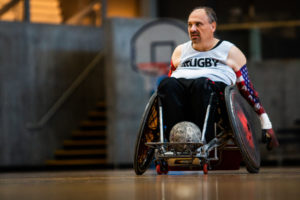
The same court plays host to Goss’ rugby practices, although with a lot more “bashing and all that.”
Like the power soccer players, adaptive sport has had an impact on his life. “I was independent before, but when I came out here it really made me more independent.” he says. “Being around 15 other guys in wheelchairs, you learn a lot.”
It’s hard to describe Goss as anything but independent. He lives on his own – his parents are still back in his hometown. He drives into practices by himself. The little things, like easier methods of getting into that car, are what he’s picked up in Phoenix.
Goss’ independence shouldn’t come as a surprise.
Studies have long harked about the benefits of adaptive sports. A 2009 survey from Disabled Sports USA found that the employment rate of its athletes was twice that of the general disabled population.
These results were backed up by a separate study in 2015 by academics from the universities of Washington and Houston. Their study showed that, for the first ten years of participation, each year of sports increased the employment rate by four percentage points.
Of course, Goss’ independence requires adaptations. A wall knocked through in his house. A special type of car. Water to squirt on himself when training.
On his right arm is a tattoo – “remember the pain.” Nearly ten years on from his accident, he hasn’t forgotten yet.
“The best kept secret in the Valley”
Across in Mesa, two boys race each other in their wheelchairs.
The court that they’re on isn’t as glamorous as Ability 360’s purpose-built center, but it has no need to be.
This is Arizona Disabled Sports – the Valley’s other major adaptive sports program. There is a younger vibe here, and that’s visible today – it’s a wheelchair basketball practice, and five kids have shown up.
“They say that we’re the best kept secret in the Valley,” remarks Taylor Wilson, Arizona Disabled Sports’ Program Supervisor. The smiles on the faces of athletes suggest she may be on to something.
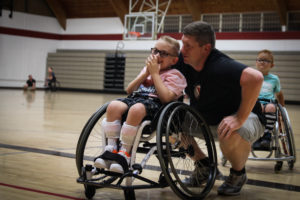
The Mesa-based nonprofit, founded in 1989, is a smaller operation than cross-town Ability 360, although they do have three permanent staff members. They offer a variety of sports – from track to bowling, and from cycling to kayaking.
Today, though, it’s basketball. Coach Christiana Chambers is lining the players up for shooting practice. Once, she was in their place – “I started with Arizona Disabled Sports when I was 13 years old. I was an athlete all throughout junior high and high school, and then when I graduated high school, I decided to become a coach.”
She pauses to think through the numbers. “8 years,” she says. “I’ve been a part of the program for 8 years.”
To Chambers, just being able to compete makes a huge difference for players. “For them to come here,” she says, “to be able to call themselves an athlete, that impacts them the most.”
“It’s a pretty penny”
“I would say that funding is probably our biggest [problem] right now,” Wilson says.
It isn’t an unexpected statement. Adaptive equipment, often heavily specialized, comes at a price.
At Ability 360, Baionno helps the players to apply for funding, and the facility provides some of the equipment. Beyond that, the athletes are expected to help fundraise for themselves.
Dalen Soto is one of those athletes, and he recently bought himself a power soccer chair – after three years of fundraising. “It’s quite a bit of money because it’s customized to my needs,” he says. “I think altogether it’s about $12,000. It’s a pretty penny, especially when you try to raise it on a limited income.”
Arizona Disabled Sports provides equipment for its athletes, and Ability 360 also helps out its players. If it wasn’t for that help, then many, including Awale, wouldn’t be able to participate.
Neither would Carl Farley’s daughter. An athlete in Mesa, she’s taken part in archery, track and now bowling. He said that a chair for her would cost around $5,000, a figure that “would definitely be cost prohibitive for us. She wouldn’t be able to participate.”
Expenses go beyond just equipment. The dispersal of teams makes travel a problem too. Baionno says that she only knows of a single team in each surrounding state, with the exception of California. Arizona’s three teams are all based at either Ability 360 or Arizona Disabled Sports.
It’s a problem she thinks will only be fixed via education, and making people aware of the sport. This is no mean feat – while Paralympic coverage is increasing, it’s still just six years since NBC devoted only five and a half hours of TV coverage to the London games.
Yet progress is being made. Ability 360’s sides are becoming travel teams for the first time ever, and will host a tournament in the coming months. Opportunities are continuing to grow.
To help make ends meet, they’re looking for sponsors. It’s a struggle, as a newer side, for power soccer to draw in backers. The challenge isn’t quite so steep for Goss’ wheelchair rugby team, who have won national championships.
“You’ve got to work slowly”
Ben’s ambitions are high. “The goal is to play U.S.A. ball,” he says.
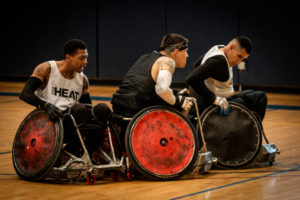
Goss’ coach, Scott Hogsett, had earlier laughed at his comments, questioning why Ben hadn’t attended a recent national team camp. There’s a clear rapport between the two, and the comment is light hearted. Hogsett likely knows best, though. After all, he does have multiple Paralympic medals to his name.
Yet Goss is self-aware. “I’m only four years in,” he concedes, “so you’ve got to work slowly.”
In Phoenix, at this point in time, maybe he should start dreaming. After all, adaptive sport here has never been in quite so good a place.