GROWING AN URBAN FOREST ON PHOENIX’S HEAT ISLAND
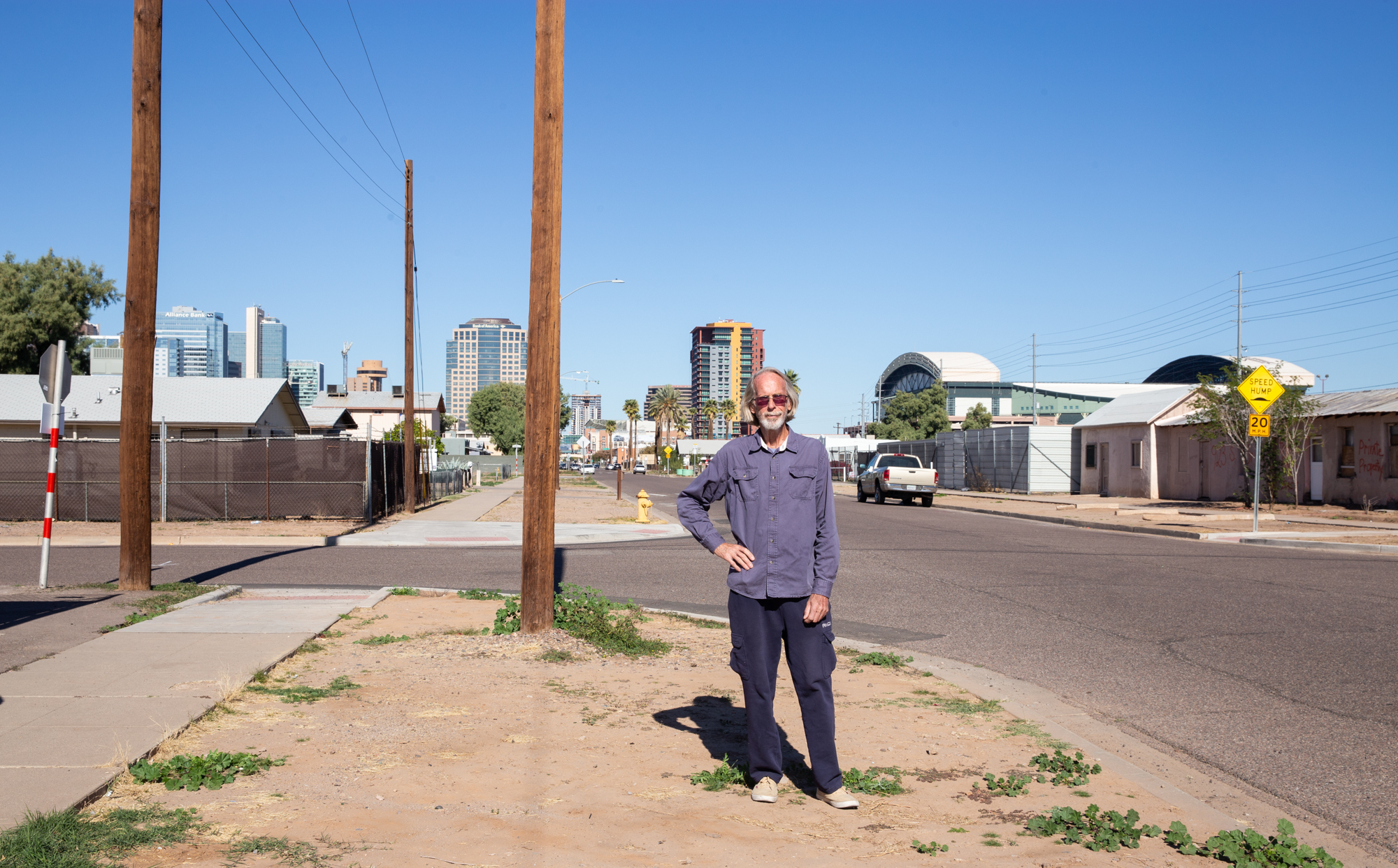
As president of Central Park Neighborhood Association, Lyle Plocher has prioritized planting trees in the small South Phoenix neighborhood. He said the group intends to apply for a city grant for funding to plant trees in this right-of-way next year. At just over 6 percent, Central Park has one of the lowest canopy coverage rates in all of Phoenix. (Photo by Molly Duerig)
South Phoenix’s Central Park neighborhood was almost barren when Lyle Plocher moved there in 2008, and the lack of trees or shade made dealing with some of the worst temperatures in the city difficult.
Plocher, his neighbors and everyone else in Phoenix are victims of the urban heat island effect. This occurs in areas with a great deal of infrastructure, since all the concrete and asphalt absorb the sun’s rays. That trapped heat then radiates back out into the city, driving temperatures higher and keeping areas warm even after the sun has gone down.
Many cities across the country face this problem, but few can compete with Phoenix temperatures climbing past 110 degrees in the summer. In fact, the heat can get so dangerous that 175 people died from heat-related issues last year, according to Phoenix’s chief sustainability officer, Mark Hartman.
“Heat is a silent storm,” Hartman said. “If you have, you know, a tornado coming in, you definitely know, and everybody takes precaution. But with heat, it’s kind of silent. It’s a silent killer. And so you’ve really got to watch that.”
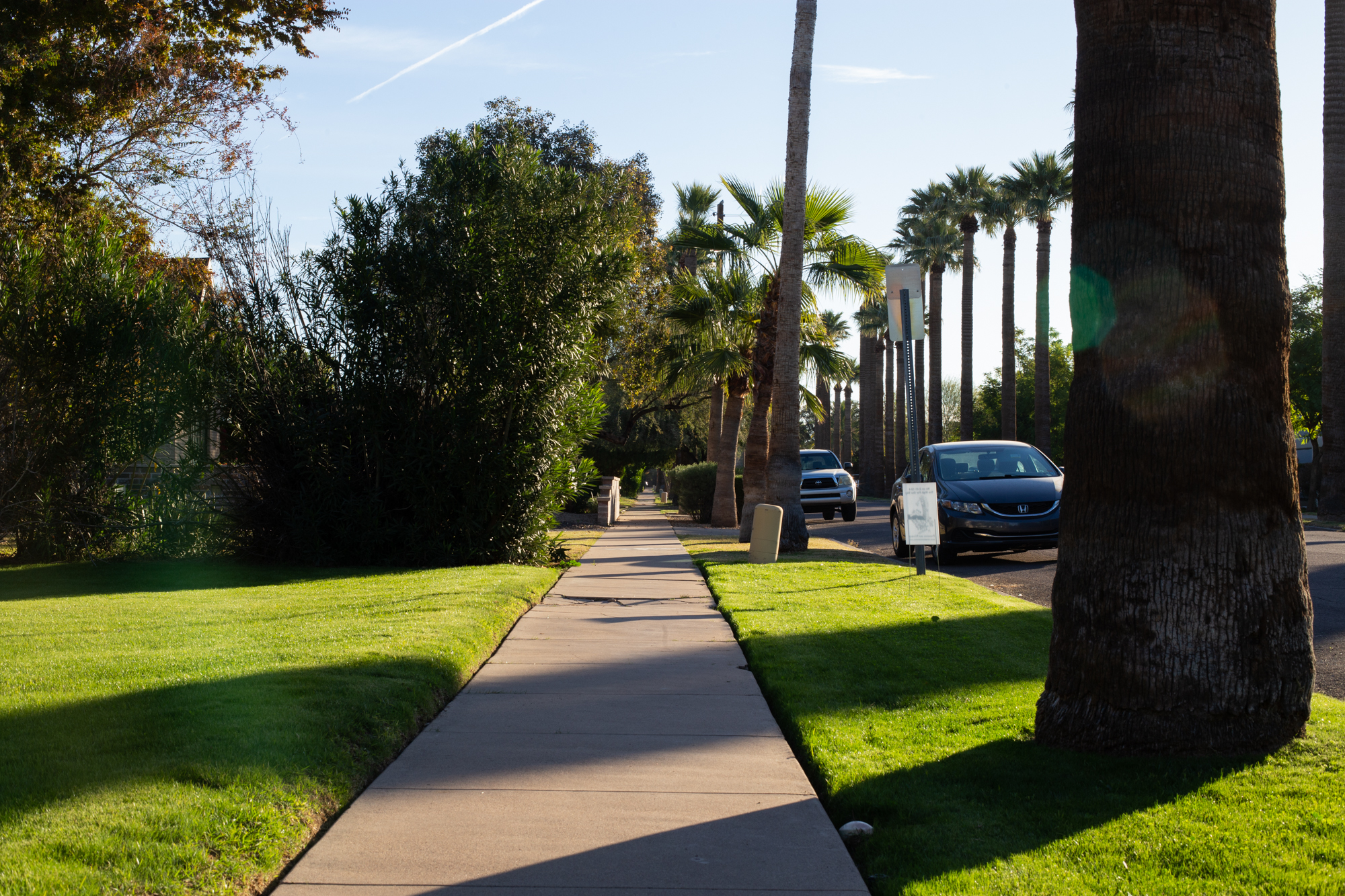
Although palm trees thrive in Arizona's arid climate, they do not provide much shade. Palm trees actually belong to the monocot family of flowering plants, making them more closely related to grass than trees. (Photo by Molly Duerig)
As it turns out, one of the best ways to combat the urban heat island effect is to make the urban environment greener. Arborist Nicole Rodriguez, alongside others in the downtown community, has been fighting for more trees and shade for the past year.
“There’s nothing else in nature or our manmade environment that can do what a tree can do,” Rodriguez said. “A tree can sequester carbon, a tree can mitigate stormwater runoff, a tree can provide shade, but also a tree can create a cooling atmosphere more effectively and efficiently than a manmade structure can.”
If only it were so simple to just keep planting trees. The city of Phoenix spent more than $550,000 in 2017 on maintaining their urban forest, and that doesn’t even factor in what it costs private citizens and businesses to do the same. On top of that, just understanding the nuances of planting the right tree in the right place and then caring for it causes a variety of problems across the board.
Despite the challenges, Plocher, the city of Phoenix and Rodriguez haven’t given up. Each one is working together, in different ways to fight the rising temperatures with trees and shade.
PLANTING THE SEEDS OF SHADE
Plocher moved to Arizona because it’s where his wife came from, but her interest in the local art scene is what drew the couple to South Phoenix. They wanted to stand apart from the Roosevelt Row Arts District and Grand Avenue, so they moved close to the Bentley Projects Gallery, near the Warehouse District. They even opened an art gallery and a real estate office downtown, until the real estate crash forced them out of the building.
But throughout those years, as the rest of downtown developed, Plocher said he realized South Phoenix had plenty of room to grow, too.
“In my capacity as a real estate agent at the time, I was always involved with trying to tell people the potential the south side of downtown had,” Plocher said. “It was kind of undiscovered and yet to be developed.”
So, two years ago, he helped found Central Park’s neighborhood association. Their first big project? Planting 35 trees with a grant from the Phoenix Neighborhood Services Department to invest in future shade. The only issue? Deciding who would maintain them.
According to Plocher, even though they planted the trees outside of any residents’ property, the city expected nearby homeowners to take the burden of responsibility. That meant watering the new trees regularly and keeping the area clean.
Instead of calling it in and leaving their neighborhood devoid of trees, residents stepped up to take matters into their own hands.
“So rather than just kind of having things not getting done because, ‘which side is going to do what?’ we’ve just went forward and asked the home owners to take responsibility for this,” Plocher said. “And the city would love to see trees, but they don’t want to see them planted and die. It’s important to the city that people take responsibility for the trees.”
Once they cleared that hurdle, the tree plantings continued, with dozens of volunteers helping plant another 35 trees throughout the year. And while they require a fair bit of care right now, Plocher said they’ll eventually be fine on their own. That’s when they’ll pay the neighborhood back by providing cooler, shady paths to walk.
Plocher added that he does think the temperatures keep people from enjoying the area. Even though Central Park is only a short walk from downtown, the high temperatures deter people from actually getting there.
A GREEN PLAN IN A DRY ECONOMY
This lack of trees and shade and the resulting temperatures caused by the urban heat island effect is common in less affluent areas of the city. According to the city of Phoenix’s tree canopy coverage map, Central City, which contains the Central Park Neighborhood, only has 6.1 percent canopy coverage. Compared to Paradise Valley, there’s a 12 percent difference.
Knowing these discrepancies exist, city staff turned to Richard Adkins. He had been hired as Phoenix’s forestry supervisor in 2006 with the goal of creating a tree and shade master plan. This document, once written, laid out the state of the city’s urban forest and created a roadmap of how to increase canopy coverage to 25 percent by 2030.
After Adkins worked across departments to co-author the plan, city council approved it in 2010. But at that point, the Great Recession had a grip on the entire country. Hartman, who replaced another of the master plan’s principal authors in 2014, said the city had to make difficult choices.
“Should we close down community centers or should we reduce the number of trees we’re planting?” Hartman said.
So, from 2010 to 2017, the city seemed to enter a holding pattern. According to figures from Phoenix’s Tree City USA application, provided by Adkins, the city spent an average of $537,000 on its urban environment during those eight years.
Data from the tree inventory, also provided by Adkins, shows city staff narrowly planted more trees than they removed during that same time frame. The 2,125 net total was only a tiny fraction of the city’s 92,880 publicly maintained trees.
So, eight years later, Phoenix’s canopy didn’t see much growth. It currently covers 11.9 percent of the city, putting the canopy just below the halfway point toward the 25 percent goal.
There are still 12 years left to reach 25 percent, though, and Adkins is continuing to reach the finish line. He said the city is always trying to plant new trees, and there have been plantings in Encanto Park this November. In addition, Adkins constantly focuses on keeping the subject on the minds of both residents and policymakers.
“You’ve got to educate both sides of the story on the value and the importance of trees, especially here in the desert southwest,” Adkins said. “Not only the economic and environmental importance, but human health.”
Hartman also added that city council dedicated an extra $500,000 to the city’s tree planting budget this year. According to him, that will help Phoenix pick up the pace.
But who convinced city council to start paying attention to the trees? Though the answer isn’t clear-cut, some members of the public have certainly done a great deal to ensure trees and shade were on the city council’s radar.
PEOPLE WHO SPEAK FOR THE TREES
When the Renaissance Phoenix Downtown Hotel decided to remove the shady ficus trees in their outdoor plaza last November, people in the community took notice. Dwayne Allen, owner of The Breadfruit and Rum Bar restaurant, said the plaza was a popular spot where people went to enjoy their lunch. So when local advocate Stacey Champion started a petition to ensure the Renaissance owners replaced the old trees with a different, shady tree, the effort snowballed into something larger.
Champion, along with Allen, Rodriguez and other concerned community members, formed a citizen’s ad hoc committee dedicated to protecting downtown Phoenix’s urban forest. Their primary goal was to draft a set of best practices and ordinances and then ask city council to implement them. Along the way, Allen said the ad hoc committee discovered the dormant tree and shade master plan.
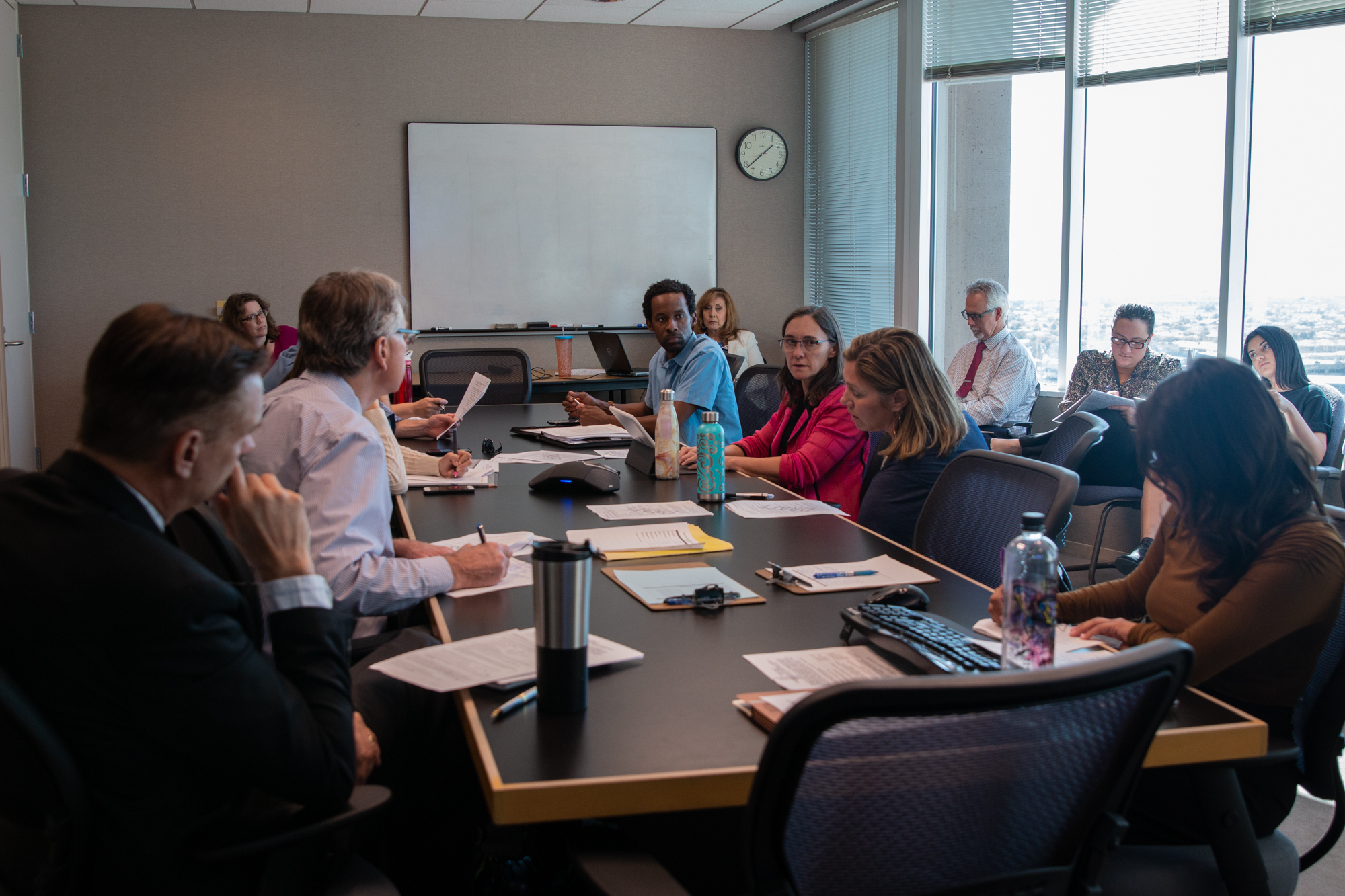
Members of the city's Urban Heat Island/Tree and Shade Subcommittee discuss recommendations for city council to improve canopy coverage in Phoenix. The subcommitteee meets at City Hall once a month. (Photo by Molly Duerig)
At that point, Rodriguez said a particular part of the plan stood out to the committee. The very first action item called for the city to implement a council approved tree and shade citizens committee that focuses on tree issues in an urban environment.
Despite that fact, the ad hoc committee had to petition for a place on city council’s agenda so they could share their ideas to protect Phoenix trees. When they eventually had their chance to speak at an April 18 meeting, Rodriguez said they asked for two things.
“We asked that our ordinances that we developed and devised that were catered towards an arid climate would be implemented by the city of Phoenix, and to also implement a tree and shade committee,” Rodriguez said. “We got neither.”
Instead, city council created the Urban Heat Island Tree and Shade Subcommittee underneath the Environmental Quality and Sustainability Commission. Allen was asked to co-chair the subcommittee and Rodriguez was invited to lend her expertise as an arborist. The entire group of eight members was asked to provide a list of recommendations to city council on how best to carry out the tree and shade master plan.
The subcommittee has met one afternoon a month since May at City Hall, and intends to finalize its recommendations in the spring of 2019. At the same time, Rodriguez said there isn’t enough public input at subcommittee meetings, and that no regular citizens have attended.
In addition, the subcommittee is only making recommendations. According to Allen, city council can adopt some of the recommendations, all of them or reject them outright. Despite the uncertainty, Allen said the subcommittee’s existence itself is a sign city council is open to listening.
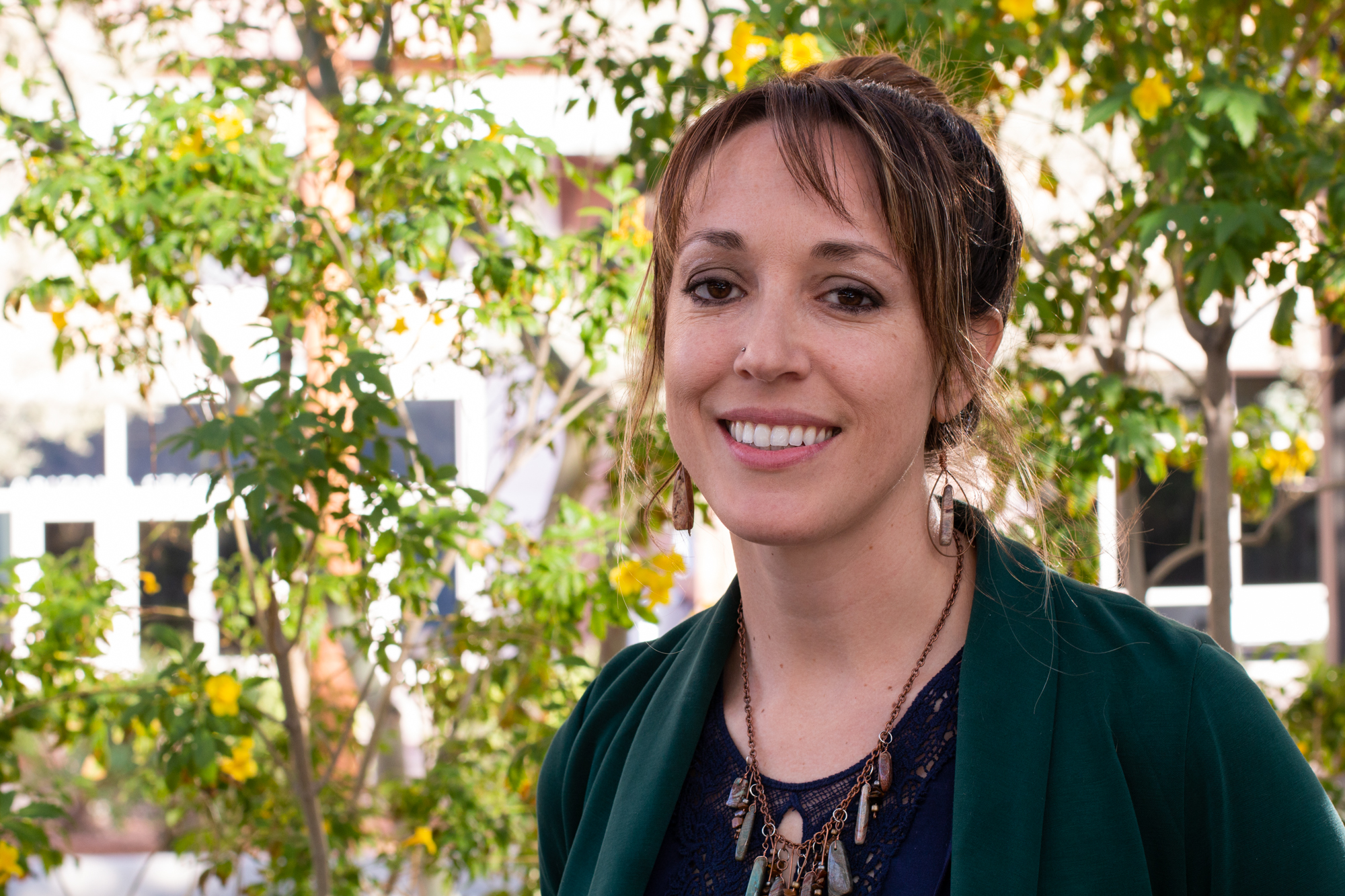
Nicole Rodriguez, a certified arborist and natural resource specialist for Arizona Public Services, was actively involved in the citizens-led committee that formed to pressure City Council to prioritize trees in December 2017. She was later asked to serve on the subcommittee. (Photo by Molly Duerig)
FINDING THE FOREST THROUGH THE TREES
While all of these efforts may not be coordinated in perfect harmony, the work is still being done. Despite a limited tree planting budget, pressure from the public helped Adkins put the tree and shade master plan back on track. And even though Plocher said he had no idea a tree and shade subcommittee existed, he has worked with the city of Phoenix to make his own neighborhood greener.
In the end, even though it’s not clear whether Phoenix will reach its goal of 25 percent canopy coverage by 2030, much like a tree itself, efforts to do so are steadily growing. All of the people involved may be a significant factor in fighting against the dangerous temperatures caused by the urban heat island.